


You publish a post.
People like it.
Someone shares it.
Your views increase.
For a moment, it feels like progress.
And it might be.
Those signals can show that people are seeing and responding to your message.
But there’s another question worth asking:
What happens after someone consumes your content?
Do they understand the lesson?
Can they apply what they’ve learned?
Do they know where to go next if they want more help?
Or does the experience end when they finish reading or watching?
This is a problem worth examining if you’re building a podcast, growing a business, or creating content to help people.
Because getting attention is only one part of the audience journey.
You also need to understand what happens after people discover your work.
The difference between attention and action.
Imagine you’re a podcast host.
You publish a Reel explaining one lesson from your latest episode.
The Reel receives 2,000 views.
That’s useful information about its reach.
But those views alone don’t tell you how many people listened to the full episode, tried the lesson, or returned for another episode.
Now imagine you’re an entrepreneur.
You publish a post explaining a common customer problem.
People like it and leave comments.
That tells you something about engagement.
But it doesn’t automatically tell you whether people understood your service, visited your website, or took another meaningful step.
None of this means likes and views are useless.
They can help you understand how people respond to your content.
The problem comes when you treat one metric as proof that your entire strategy is working.
Different goals require different measures.
If your goal is awareness, reach and relevant profile visits may be useful.
If your goal is building trust, thoughtful replies and repeat engagement may provide helpful signals.
If your goal is action, you need to measure the action itself.
Don’t just measure whether people saw your content. Understand what you wanted that content to help them do.
Why people sometimes don’t take the next step:
Sometimes, the problem isn’t your expertise.
It’s the path you’re giving people.
Imagine a podcast host creates a helpful clip about improving listener engagement.
The clip teaches three useful lessons.
But it ends without explaining what listeners can do next.
Someone might enjoy the content and keep scrolling.
That’s not necessarily a failure.
They may have received the value they wanted.
But if the creator’s goal was to help people explore the full episode, the next step wasn’t clear.
Now imagine the clip ends with a simple invitation:
“If you want to practice this, choose your next episode and write down one question your listener should be able to answer afterward.”
That invitation helps the viewer apply the lesson.
If the creator also wants to encourage further listening, they could connect the topic to the full episode.
Each action has a purpose.
The important thing is to avoid asking people to do everything at once.
When your content has too many competing calls to action, it becomes harder for people to decide what matters most.
Three ways to create a clearer path forward:
1. Give each important piece of content one primary next step
Before you publish, ask yourself:
What is the most useful thing someone can do after consuming this content?
Your answer should connect to the lesson.
If you teach a podcast host how to improve an episode opening, invite them to review their next introduction.
If you help entrepreneurs clarify their message, ask them to rewrite one sentence explaining what they do.
If you teach a personal-growth lesson, invite people to try one practical exercise.
You can still include other useful information.
But choose one primary action so the audience understands where to begin.
Not every post needs a click or a conversion.
Sometimes, the most useful next step is reflection, practice, or a meaningful conversation.
2. Match the next step to the audience’s needs
A call to action works best when it makes sense in the context of the content.
Imagine a Reel that teaches a simple editing tip.
A useful next step might be to try that tip in the next video.
Asking someone to buy an unrelated product would feel disconnected from the lesson.
The same principle applies to podcasts.
If your episode explores discipline, you could give listeners a small exercise that helps them practice consistency.
If your episode explores audience growth, you might invite listeners to review how their latest content connects to their wider strategy.
Your next step should feel like a natural continuation of the value you’ve already delivered.
3. Measure the action you actually want to encourage
Once you’ve decided what action matters, choose a way to measure it.
For example:
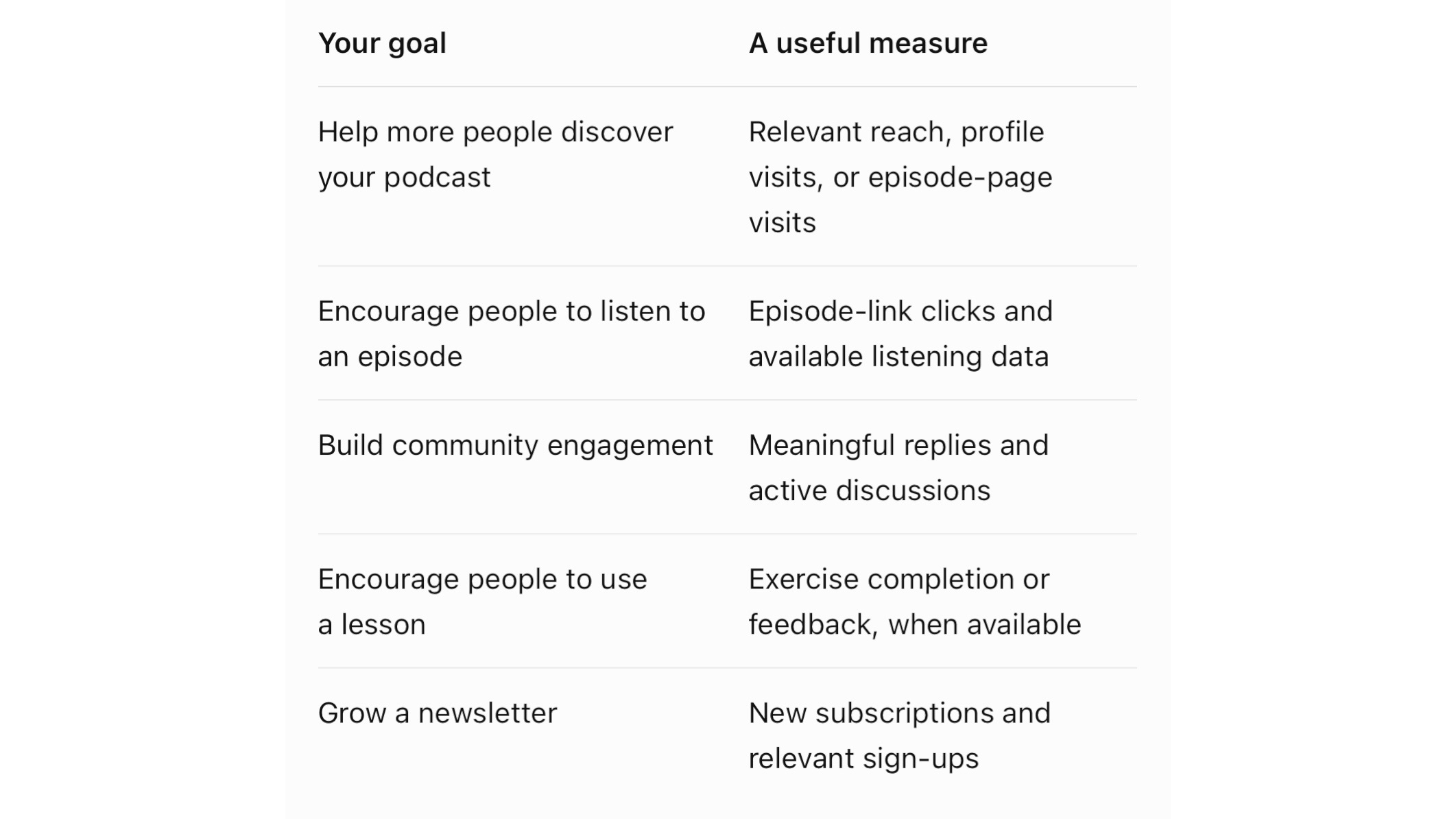
These measures aren’t perfect.
Someone might benefit from your content without clicking anything.
Someone might click a link without taking further action.
Use metrics as clues, not complete explanations of people’s behavior.
The goal is to understand whether your content is helping you move toward the result you intended.
How this connects to the Funnel BODY Blueprint™:
I use the human body as a simple way to explain how a business funnel works.
The Funnel BODY Blueprint™ has four connected stages.
HEAD — Awareness
Help the right people discover you.
Your content creates opportunities for people to find your work and recognize that your message is relevant.
CORE — Nurture
Build trust through useful information and meaningful connection.
Help people understand the problems they face and experience the value of your expertise.
LEGS — Momentum
Help people take action.
Give them a practical next step that connects to what they’ve learned.
RETENTION — Return Factor
Give people reasons to continue the relationship.
Connect your lessons, provide useful follow-up, and make it easier for people to find more of your work.
Today, we’re focused on LEGS.
You’ve helped people discover you through HEAD.
You’ve given them reasons to trust your message through CORE.
Now, you can help them apply what they’ve learned.
This doesn’t mean pushing everyone toward a sale.
It means making the next useful step clear.
For a podcast host, that might be trying an exercise from an episode.
For an entrepreneur, it might be clarifying a business message.
For a creator, it might be applying a lesson to their next piece of content.
The next step should serve the audience, not simply satisfy a metric.
A 10-minute content action audit:
Let’s make this practical.
Choose one piece of content you’ve published recently.
It could be a Reel, social post, podcast episode, or newsletter.
Step 1: Identify the goal
What did you want this content to accomplish?
Did you want to help people discover you, build trust, teach a lesson, or encourage a specific action?
Choose the main goal.
Step 2: Identify the next step
What could someone reasonably do after consuming the content?
Write it in one sentence.
For example:
“After watching this Reel, a podcast host can rewrite the opening sentence of their next episode.”
Step 3: Check the connection
Does the action follow naturally from the lesson?
If the content teaches one thing but the call to action asks for something unrelated, consider improving the connection.
Step 4: Choose a measure
Decide how you’ll tell whether the action is happening.
If your goal is episode listening, review the available episode-link clicks and listening data.
If your goal is discussion, look at the quality of the responses.
If your goal is helping people apply a lesson, invite them to share what they tried.
Not every outcome will be visible in your analytics.
That’s why a combination of measurement and conversation can be useful.
Step 5: Make one improvement
Choose one change.
Simplify your call to action.
Explain the next step more clearly.
Connect your post to a related lesson.
Or remove an unnecessary request.
Then observe what happens.
You don’t need to rebuild your entire content strategy in one day.
Start by improving one connection between the value you provide and the next step you invite people to take.
Your content doesn’t have to sell something to be useful.
There’s an important distinction here.
Action isn’t always a purchase.
It isn’t always a click.
And it isn’t always another piece of content consumed.
Sometimes, the best result is that someone understands a problem more clearly.
Sometimes, they practice a skill.
Sometimes, they change how they approach a task.
Sometimes, they return to a conversation because the previous experience was useful.
Those outcomes may be harder to measure, but they still matter.
Your content strategy should reflect what you’re trying to accomplish and the kind of experience you want to create.
When your goal is education, help people learn.
When your goal is practice, give them something to try.
When your goal is discovery, make your expertise easier to find.
When your goal is retention, create meaningful reasons for people to return.
Clarity about the goal helps you make better decisions about what to publish and how to evaluate it.
What I want to build through The Warriors Haven Podcast:
Through The Warriors Haven Podcast, I explore discipline, identity, energy, resilience, and the forces that shape how we think and act.
I want these conversations to offer more than information.
I want listeners to have ideas they can reflect on, lessons they can apply, and questions that help them understand themselves and their lives more clearly.
Sometimes, the next step will be a practical exercise.
Sometimes, it will be another conversation.
And sometimes, it will simply be taking time to think about a lesson before deciding what to do with it.
The important thing is that the experience serves the purpose of the content.
That’s the principle I want to bring to my wider content strategy, too.
Not just getting attention.
Not just collecting engagement.
But creating useful experiences that help people move forward.
🎯Your challenge for today:
Look at your most recent post, Reel, or podcast episode.
Ask yourself:
What was the main goal?
What useful lesson did I deliver?
What next step did I offer?
How will I know whether that step is happening?
Then make one improvement.
You don’t need to make every post longer, add more information, or include five different calls to action.
You may simply need to give people one clearer next step.
Your audience shouldn’t have to guess what to do with the value you’ve given them.
Help them understand the next step, make it relevant, and measure what matters.
~Your Favorite Drill Sergeant, Jay 💖